Showing posts with label Friendship. Show all posts

10 July 2015

How Long Do I Wait?

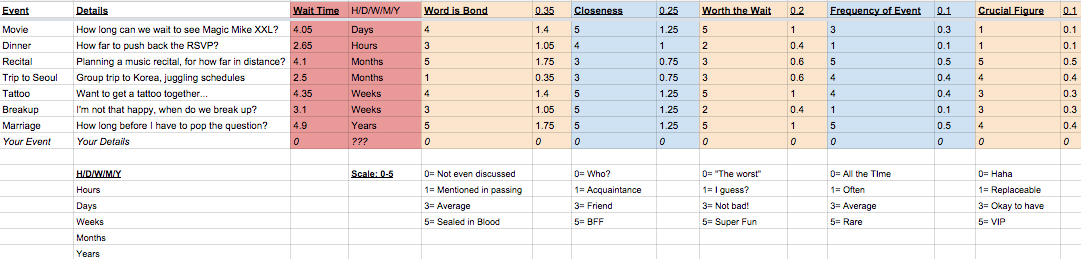
I’m not often called a genius, for obvious reasons, but sometimes I get so close to genius it’s confusing. For example, I’ve solved the “how long do I wait" problem. With a spreadsheet, as per usual.

See, I tend to always be waiting for a friend to do something. Maybe it’s to catch a specific movie, maybe it’s to go on vacation, whatever. I’m loathe to do anything alone so part of that always wanting companionship thing is agreeing to wait. And wait, and wait.

My friend pointed that this was ridiculous and offered up a few different strategies to fix it. She was very helpful. I'll try a few of her suggestions but in the meantime, we came up with a formula to mathematically figure out how long a person should reasonably wait. After extensive testing, our system basically works for every situation, including and up to “How long should I wait to break up?”

So yeah, all everything you need is right here: "How Long Do I Have to Wait: An Answer," with a step-by-step and explanations below. It’s an incredible system, and one I’ll be applying to my own life immediately.

STEP ONE: Pick a time frame. Is it hours, days, weeks, months, or years? Most of the time, the answer is obvious. When in doubt, pick the shorter time frame.

STEP TWO: Go through all five categories, scoring from 0-5 for each. Zero is low, five is high. The formula is weighted like this:
(A*0.35)+(B*0.25)+(C*0.20)+(D+0.10)+(E+0.1) = How Long Do I Wait
STEP THREE: Inform your friend(s) how long you’ll be waiting. That’s it! Feel free to live your life now without suffering guilt about how you didn’t wait for someone to do something.
Categories Explained: 
Word is Bond, 35%
This category covers how fixed in stone the plans were. A passing “Oh yeah, we should watch that together merits just a one on the scale. But if you’ve looked deep into each other’s eyes and promised to do something together, that’s a five. I can’t emphasize enough how important this category is, thus it’s weighted very heavily because the agreement part is where most of the future disagreements stem from. “But you said you would wait!?!”

Closeness, 25%
How close are you to the person you made a commitment to. Is it just a so-so friend, or perhaps a co-worker that you’re friendly with but owe nothing to? A five on the scale is someone who will slit your throat (deservedly) if you ditched them. Irreparable betrayal really.

Worth the Wait, 20%
Is experiencing this event with the other person going to be worth the wait. Sure, you could go ahead and watch the Game of Thrones finale with anyone, but wouldn’t it be better to wait and enjoy it with your die-had fan? If so, that’s a high Worth the Wait score. Also, this is the category to take into account how important this thing is to the two of you. Is your bond with so-and-so all about roller coasters and you’d have the most fun with them? Or you traditionally ALWAYS do this one thing together. Then that’s a five.

Frequency of Event, 10%
Is this the kind of thing where opportunities will come again? Or is it a once-in-a-lifetime deal? A brunch or a movie can happen quite often, so that would score low. Taking a trip to pet penguins in Antartica? That’s probably pretty rare, score it a five.

Crucial Figure, 10%
Is the person you’re waiting for a big part of the event? Are they central to the planning process, will they have connections to free housing or VIP seating? That’s what this category is about. If this person is irreplaceable, then they should rank highly.
Let’s take a real life example. Piper is headed to jail for transporting drug money across international borders. Her fiance, Larry, promises that he’ll wait for her to be released before continuing Mad Men. How long should Larry wait?

He verbally promised he would wait (score it a 5), he and Piper are engaged (5), it seems like watching Mad Men is their couple thing (4), they could likely replace Mad Men with another show when she gets out (2), and Piper isn’t really a crucial figure to watching the series (1). Final answer: 3.9.

The timeframe part is up to Larry. If he wants to be a backstabbing, lying asshole, then he can wait 3.9 hours to watch Mad Men. If he wants to be a stand up guy, then he can wait up to 3.9 years for Piper to get out and watch Mad Men together. Your call Larry.

Please, use the spreadsheet, test it out. I think you'll find that it's both simple and effective. As always with my world changing spreadsheets, I welcome comments, questions, and improvements. This is just an alpha version, created in an evening, but I think it has the potential to change how we interact with each other. As rational, responsible adults who shouldn't get upset at each other for superfluous stuff. You know, like what I did when my friend ditched me to get her tattoo. I'm still holding that one against her...

Caveat: This “how long should I wait” formula doesn’t work for things that can only happen during certain timeframes. If an event happens on a specific date and time, then it’s simply a matter of whether you can go together or not. Along those same lines, this formula doesn’t work for things that you absolutely can’t delay. Like, say, childbirth. “It says I should wait 3.47 weeks to give birth, should we go ahead and tell the doctor?” No.

13 June 2011

A New Refutation of Time And Space

Listening to: Consequence, "Disperse." If you knew this guy was Q-Tip's cousin, you were one up on me. In about a month, Michael Rapaport's Tribe Called Quest documentary comes out, so let's get excited by listening to this amazing track I didn't even know about until four days ago. "Please disperse, please disperse!"

As I've noted on here before, I'm a big time pusher. Anyone around me is subjected to lots of "you have to download/try/read/use/steal this, it's the best!" On this blog I'm always using my listening to and currently pushing tags to throw out music or articles or sites I'm into at the moment.

Now take all that energy and imagine what happens when I turn it toward proselytizing blogging. I'd say eighty percent of the time my efforts fall on deaf ears, even as I'm physically making people create logins and avatars and first posts, but sometimes I give someone the gift of blogging and they take to it immediately and for a sustained amount of time. Usually they keep doing it for a few months and then dribble off, never to post again, relegated into my dustbin of friend blog memories. Well, last March I gave my friend Reena the gift of blogging (and Google Reader) and she's since outpaced me in just about every measurable metric.

In just over a year she's started writing for other sites and magazines, is on the verge of starting a podcast, bought her own domain name, learned to code and design her template, and the other day even solved one of my HTML problems. Student surpasses teacher?! Is this what it feels like to feel parental? Blogosphere, I've unleashed reena.me and she's coming to take over.

Reena's interests and expertise are as varied as her hair is big and she's got observations, rants, and spins on a broad range of topics. Here's a sampling of her posts. Go RSS and follow her why don't you? Because she's like, my greatest blogging protege ever!

22 April 2011

O is for Other, P is for People...

Listening to: Luna, "Everybody's Talking (Harry Nilsson)"

Talking with a friend the other day, she lamented the fact that she seemed to be getting an extra earful of other people's problems recently. She requested that we analyze what she was doing to be the target of such rants, diatribes, and egocentric repetitive problem venting with no discernible positive actions or solutions. I said I didn't even have to analyze anything. I already knew her problem: her friend PR was all wrong. Let's look at what an actual public relations firm does. Actually no, that's pretty obvious, instead let's dive right into what friend PR should do.
Control access: A good firm manages what you are willing to do and sets boundaries about what is acceptable -- and when exceptions can be made. Think of it as crowd control and preventing yourself from being overwhelmed. When you are celebulous (as you most certainly are), people need you for a variety of things. The problem is, you only have a life to live, one world to turn. Friend favors, expected attendance at events, shoulders to cry on, mundane office gossip, random requests, all of these things can be draining. As much as you want to be there for everyone, you can't be. Every starlet has a few people manning the velvet rope. You should too.

Sample phrases:
"I don't do airport runs after midnight. Get your own magic pumpkin."
"I'm running out the door, but we can do this over text. Or Twitter."
"That's a baby shower and a colonoscopy in one? Thanks but I'll pass."


The key here is to not feel like you have to apologize. "Sorry" is nice but not part of the PR vocabulary. You don't have to feel bad about telling someone that you can't do something. We are grown ass people. "No" is enough. Trust me, as adults I'm sure people will appreciate knowing what you're available for and what you're not. "I am good with illogical career advice, irresponsible financial planning, Mac product recommendations, details about mega-drama that I'll inevitably spread later, and weekday runs to Costco. I can also say 'no' to that dress."

Marketing: This brings me to the next component of friend PR. Come up with a comprehensive plan to promote the things you are good at, preferably with a memorable tagline. For example, a classic: "Always there when you call, frequently on time. (But I'll ditch you if my boyfriend is around.)" The message is honest and clear, proper expectations are formed, and friends are made aware of your positive/negative traits. Simple is good. Individual messages can also be tailored to different demographics.

"Carefully reassembling the pieces from your emotional wreckages since 1997."
"When you need to bitch, call a friend. Me."
"Unbiased advice, almost never."
"The best part of waking up is I'll be out the door by seven."
"I used to fiend for your ex-girlfriend/sister/best friend/mother, but never went up in her."


Advertising: Now you gotta get this information out there. Take all that stuff you decided on in the marketing meetings and then tell people about it. Drop things into conversation about how you're "always awake at five am, and it's important that my friends can call at any time." People will appreciate knowing this tidbit about you. Or tell them about "another friend" who always bores you with the annoying recaps of his essentially non-existent dating life. He'll get the hint soon enough. Remember, good advertising can be sometimes be passive(-aggressive), oftentimes it has to be. The most important thing to do is focus on expression and effectiveness. Tell your friends who you can be in their lives, communicate.

Nowadays I personally prefer to be a little more upfront about it, and I'm willing to gently interject mid-whatever, "Am I really the best person for this situation?" That will make them double take and really consider if I am truly the person they should be telling their "my dog went to the vet and I'm so worried about him because he shakes so bad when other people touch him that sometimes he tinkles" story. In this example, a momentary pause will reveal to both of us that I am clearly not the right guy for this particular job. Hey, I care about your dog (a little) but there's probably somebody else who will be more capable of giving you the reaction you're looking for. Maybe reach out to them? "What's their number? No, I'll go ahead and dial that for you. It's ringing... Call me later when you have salacious secrets to share."

I do have a friend who very expertly says, "Hmmmm, yeah, I think I just stopped caring." I kind of love that style too. It's all personal preference really. Just be sure to use all your tools to get the message across. Be creative, use different mediums. Think audio, video, notes, innuendo, flashing banner ads, anonymous Facebook messages from a newly created account. Whatever. You can't have this great marketing plan and then not buy the ad space to inform people.

Note: A good PR firm will also know how to damage control. That's a key component actually. You're gonna inevitably piss off some friends during your short tenure on Earth. A good crisis management team will prepare you to handle that. Sometimes.
So the aforementioned friend has a problem with people always coming to her for a patented blend of patient listening skills and hard edged advice. However this tends to lead her down the path of having too much crap she doesn't care about thrown at her. For example, she is not good with "it'll be okay" and "that sucks, I'm so sorry" talks but she's constantly being put in that position. The incessant whining about dead end relationships is wearing on her too.

Currently, she has been doing all the things a normal person does. Not picking up the phone, long delays on reply texts, going invisible on chat. Yet somehow she is still being hunted down. I told her that she needs to fire her current friend PR firm and hire me. I'll clarify her vision, recontextualize her conversations, adjust her apologetic attitude, wipe that "want to be nice" drool off her chin, and really get her on her shit. Basically I recommended a complete brand overhaul. I also said I'd waive my normal hefty consulting fee. My new suggested tagline for her: "I've always got (about) five minutes for you."

If you need, I'll be your Ogilvy & Mather of friendship too. Pretty please?

Coming soon: A detailed look at the corporate structure of friendships. A few months ago, at a bar, a friend mentioned that she had to talk to her "board of directors." When I asked her what that meant, she replied, "You know, the people who help me make major life decisions." Brilliant! I'd like to take this idea to its fullest extreme and send "Welcome to the board!" invite letters on fancy stationary. If only I had taken calligraphy that one summer camp instead of ham radio or stained glass. A lot of damn good bottle rocketry did me too. "Life skills workshops," they had to have been kidding.

01 February 2011

Shiny Happy People

Listening to: Phil Collins, "Against All Odds." As a friend duty, I'm compiling a list of my friend's top five karaoke songs. I figure it's a service that will pay off in the near future since we karaoke weekly. During these karaoke sessions I'm introduced to many songs that were once popular but I completely missed out on. So now I associate these songs with my friends, instead of the original artist. I usually prefer my friends' versions. Get thee to a studio, friends, so I can listen to you on shuffle and one track repeat.

During a dinner conversation last week, I commented to someone that he's always got friendship rivalries going on. I noted that there's usually some pair of friends in his life that are either subtly or overtly trying to secure or win a higher place on his friend totem. This got me thinking about how to create your own friend rivalry. But before we get into that, let's talk a few basic types of friend rivalries.

(1) First, there's the equitable friend rivalry. Two really great friends, two equally valuable people who might even play similar roles in your life. The more the merrier you'd think, but for some reason, these two people just can't get along. You've tried to bring them together and to plan some trio brunches but at the end of the day, "any friend of yours is a friend of mine" just gets proved false once again. The niche these two occupy in the context of your life is too small for them to ever get along. Or they're just way too opposite because they survive in independent friend ecosystems. This type of rivalry is usually subtle as neither party wants to smear their own reputation by bad mouthing the other VIP in your life. There's some real intensity here but also some great respect.
NBA Parallel: Larry Bird versus Magic Johnson.

(2) Then there's the one sided rivalry, where a friend thinks h/she's in competition with another friend but in reality, they are so far behind their target that they're never actually in BFF contention. Keep in mind, friend rivalries don't apply just to best friends, it can be for anything. The plus one for a wedding, the extra ticket to that play you scored from work, or the top spot in your phone's favorites list. Feel free to consult the Friend Hierarchy for positions that could be rivalried about. In the one sided rivalry, one person is definitely waging a campaign to take down the other -- friend war is declared and openly discussed. The unassailable friend barely cares about this matchup though because they know they'll win. Think of a sports team who is 30-2 all time versus another team but the media keeps playing it up as a rivalry and often fails. Remember, proximity does not necessarily equal rivalry.
NBA Parallel: Los Angeles Lakers versus Los Angeles Clippers.

(3) The historical rivalry. This isn't what it sounds like. While there could be a lot of actual history for this rivalry, I'm talking more about when one person competes against the ghost of another friend. "Did you ever tell ____ this? Am I the first person to have ever done ____ with you?!" This kind of rivalry is more common than you might think; and awfully common in relationships. There's nothing tangible placing these two figures in competition but one party is so obsessed with what the other one has done in the past, the heights that have been achieved before them, that they are determined to match and exceed it. The hidden tragedy is that they are competing with the past and will have to overachieve by a wide margin in order to combat the halcyon memories of yesteryear.

As the person at the fulcrum of this type of rivalry, it's very easy to milk this for good or for evil. "You know, Brent used to always make sure he got my coffee order right, and he even went back the one time they messed it up. I really liked that about him." I'm guilty of this one quite a bit, as all it takes is a little historical competition for me to be motivated to be a better friend. I'm always gunning for that almost top spot as you should know.
NBA Parallel: Kobe Bryant versus Michael Jordan.

(4) Another very common rivalry is the new kid on the block type. Sometimes when you gush over a new person, the old friend starts to feel a little slighted. "Wait," he thinks, "we used to do that. He used to talk about me that way." This creates anxiety in the old friend as they see the potential threat of this new friend. Don't be surprised if oldie inexplicably turn their noses up at your new friendship or says things like "Whatever, you'll be over that in a few weeks. Let's see how long this lasts."

When you introduce them to each other, the new friend will be super nice and say "I heard so much about you!" while the old friend will likely dismiss them to take a fake phone call. Oftentimes this type of rivalry is mostly hype and only time can tell if it actually evolves into something real. The newbie has to achieve some success that actually bruises the oldie's friend ego before this can properly be called a rivalry.
NBA Parallel: Miami Heat versus Boston Celtics.

(5) Last, there's the hate rivalry. These two friends detest each other. Given the chance, they'd tear each other apart and you have to do your damnedest to not to even mention them to each other. Usually this comes about because the two of them had some sort of falling out and both sides can't believe that you're still friends with the other one. The hate rivalry goes a little overboard and you wish they would just get along so you don't have to panic about having them in the same room at your thirty third birthday or second wedding or something. This type of friend rivalry is not only dangerous all around but also the best for bystanders and media types (aka your other friends).
NBA Parallel: Los Angeles Lakers versus Boston Celtics.

Okay this got way too long so I'm going to save the "How to Create and Maintain a Friend Rivalry 101" for a later post. Maybe I'll bring in a guest writer, my friend who I made this rivalry observation about. A true expert in the field. That would be exciting right?

Actually I'm pretty sure I missed a few broad friend rivalry categories, but there could probably be an infinite number. I will define them all in due time. It's good to make life goals.

24 January 2011

You're a good man, Jackie Brown

Listening to: Au Revoir Simone, "Hurricanes." Hailing from Williamsburg, meaning they are theoretically within a few blocks of me, Au Revoir Simone is a band composed of three ladies who all play the keyboard. Yes, an all keyboard band! Their name is a reference to Pee-Wee's Big Adventure but I so didn't get it. Probably because I've never seen P-WBA. That's probably an acronym that's never used right? My favorite part of the song kicks in at around 2:12 minutes. "This message is for all the people / The people who are always waiting."

A bonus song with the word "hurricane" in the title. "Hurricane Black," off the Mos Dub album, which remixes the lyrics of Dante Smith with reggae beats. This track with Common is smooooooth.

And this post is going to be about friendship, or more accurately, the lack thereof. For the past week or two I've been revisiting this article about Sinedu Tadesse, a Harvard undergrad who went into the infamy books for killing her roommate, and then herself, in May of 1995. Tadesse's story is haunting for what it reveals about a troubled young woman but also because her desperate attempts to reach out beyond a solitary existence is something many people can relate to on some level. The specific thing I've been going over and over is a letter Tadesse wrote after her freshman year. Read it if you're curious. She sent this letter to strangers, pleading with them for simple contact and I guess, an escape from alienation.

I tend to take friends for granted, or the simple fact of having friends. Or just a friend. When they say that having one true friend can make all the difference in the world, they ain't kidding. Not having people who care about you around, well, it sucks right? Especially in New York and other urban spaces, which can be full of people but all the lonelier for it. Or maybe urban loneliness is a myth?

It's rarely occured to me that I'd be friendless or ever alone in the world. Flippantly, but also semi-seriously, I always cite the fact that I have a twin as the reason why I've never encountered absolute loneliness. Even if George and I aren't two exact peas in a pod, at least we've shared the majority of our experiences together right?

Along these thought lines, a book that I'm looking forward to reading is Emily White's "Lonely: Learning to Live with Solitude," which is her memoir about being chronically lonely. I apologize to Emily White for putting her book in the same post with Tadesse, but they seemed related to me.

The other day, while digging around about White's book online, I came across this blog: MWF Seeking BFF. The blog's author, Rachel, moved to Chicago a couple of years ago but couldn't find anyone "to invite over to watch The Biggest Loser or to text 'pedicure in half an hour?' on a Saturday morning. To me [her], that’s what BFFs are. Not just people who know your innermost secrets, but the ones up for grabbing a bite on a whim because they love being with you just that much, and getting together feels easy and natural rather than a chore you need to pencil in."

Rachel's blog is great because she details her hunt for that elusive best friend, even if it's embarrassing or disappointing. Plus she consistently shares really interesting articles about friendship, such as this one from Ta-Nehisi Coates, about Gender and Support Systems. She's inspired me to write more about my personal exploration of friendships, and how they rise and fall, evolve, collapse, and sometimes reform. I mean, friendship is a subject I love thinking and talking about, and books like Joseph Epstein's "Friendship: An Expose," are must reads as far as I'm concerned.

18 November 2010

We Are Family

So this week saw the release of Path, a social network for fifty of your closest friends. Instead of trying to befriend everyone you know, Path is for personal connections, where exclusivity is king. They arrived at fifty by using Dunbar's Number, which is "a theoretical cognitive limit to the number of people with whom one can maintain stable social relationships." I learned about this awhile ago, pre-Friendster, and always wondered how having huge Internet social networks conflate with that theory. I hope I used "conflate" correctly as I just learned about this word and it seems handy. I urge you to read more about Dunbar's Number because it involves primates and grooming and gossip, all things people should be heavily invested in.

When I turned thirty, I tried to lead my fellow soon to be thirty-ites in a series of spreadsheet games that would allows us to reflect on and evaluate our past couple of decades. One of the things I made us do was a Dirty Thirty list, which was a list of the top twenty nine people closest to us, discounting family -- you get to add a new person each birthday. The point of the exercise was to identify the people we value and then to make sure we were making moves to progress or hold on to those friendships. As a follow up task, we'd send "thank you" or "thinking of you" notes to them for being such great friends.

Actually the point of the list was really for curiosity's sake, but I'm sure there were higher purposes around somewhere. By the way, I'd like to take a look at everyone's Dirty Thirty list, preferably soon after we befriend each other, as I'd like to know who my competition is.

I don't think Path has much of a future, as intriguing an idea as it is, because so far it's just photo sharing. As reviewers have pointed out, there's nothing that Path offers that Facebook can't with a few privacy settings tweaks. Path's website and iPhone app are very elegantly presented though, so I wish them the best.

I tend to read a lot of things about social networking and the effect of the Internet on our social lives. Zadie Smith wrote a wonderful article about Sorkin's movie the other week, and one of her observations was how Facebook's decreasing privacy protection has now flattened everyone out, making people a bland amalgam of safe updates, not too drunk photos, and censored individuality. While Facebook has filled the "I know what they're up to" niche quite nicely, the better question then becomes "who cares?"

My friend Raymond and a few of his friends are participating in a one month Facebook fast. They're quite a bit younger than me so for them Facebook is almost literal food. They've started a blog about it, The Social Notwork, and so far it reads like an addict's recovery diary, with the emotional spectrum going from anger, to wistfulness, to regret. I'm kind of hoping they fast for longer than a month, just to see what happens. Being unplugged from Facebook on a college campus must be torture.

While I'm here, let me share this post from Tweetage Wasteland with you. It's about how Facebook has ruined his birthday skills. I had the exact same sentiment and would have created a post about this topic except Dave Pell is an Internet superhero and cyber-telepathically captured my thoughts perfectly. For years and years I had a running list of people's birthdays, set on a special page on my website, which I'd update with precise regularity. On someone's big day I'd make it a point to call/email/text, even if we never talked otherwise. Now that Facebook makes it overly easy to recall someone's birthday, I've decided to boycott all birthdays. I know it makes me sound like a bitter child, but I'm okay with that.

Until I can figure out a new way to show my appreciation for someone's existence, I just can't bring myself to wish them happy birthday anymore as "remembering" is no longer really that special. I had been substituting contacting people on their wedding anniversaries this year, which has won me some karma points, but that hardly works for my non-married friends. I've thought about combining anniversaries and kids' birthdays but again, how do I show my other friends that I care?

Oh yeah, yesterday it was National Unfriend Day, as championed by Jimmy Kimmel. Defriend someone and see how it feels. Defriend me and I'll come looking for you. And not in that good way. Someone clever could probably come up with something witty about the one letter difference between "befriend" and "defriend." Not it.

20 February 2009

I'll Be There for You


You know me, I love lists, categories, and anything that involves names and rankings. Well, here's a project I've been working on for some time. Ever since seeing this NBA Archetype Hierarchy [ Image  ], I've been wondering how such a model could apply to friendships.

Even if you don't know much about basketball, it can help to take a look and see how it's set up. There are five tiers, each containing a certain archetype coveted -- or not coveted -- by NBA teams. As you can see, the top tier is an elite point guard or a refined big man. Think Chris Paul and Shaquille O'Neal, respectively. Traditionally, finding a true superstar at either position will set your franchise up for success if you can surround them with the appropriate complementary parts. (Ignore the blue dot that is Lebron James; he's a freak and doesn't really fit into any archetype.) Basically, the NBA Archetype Hierarchy defines the types of players that are available and then orders which ones are more valuable -- and also harder to acquire.

Using those guidelines, I thought it'd be fun to construct a friendship archetype hierarchy. Personally, I've always maintained a strict rule of fives for my friendship pyramids. Five tiers ranging from super close friends to acquaintances. Five "best" friends. Five important people to fill communication routines (in person, phone call, email, text, AIM). I've always tossed around the idea of a hierarchy, we all do, I'm sure. What I haven't done is come up with archetypes, or roles, that my friends fulfill. Well, now I have.

Introducing my Friendship Archetype Hierarchy. Keep in mind that by definition, this would have to be individualized for each person. Mine won't look like yours and vice versa. It's impossible, there is no generic template. Some people have a bigger tier three than a tier two. Some people have a ton of super close friends, some people have a few. It's all dependent on what kind of person you are and how you've structured your social circle.

The point of such an exercise is to figure out what sorts of roles, and support systems, you need in your life. I mean, sometimes when you think something is missing (friendship wise), you can't figure out what it is exactly. You miss a specific person maybe but at the same time, what you're also missing is someone to fill their niche. Not to say that people are replaceable, because they're not, but having a broad view of the sorts of niches you require for maximum happiness should illuminate something about yourself.

I mean, if friends are a huge part of filling up our happiness meter, shouldn't they deserve just as much thought and study as our careers, relationships, and families? After all, friends contribute heavily to our hierarchy of needs don't they?

Lest you think that such an exercise is frivolous and entirely narcissistic, there's a lot of ramifications for figuring out how to create friend hierarchies. Think about the current state of social networking. You may have 300 Facebook friends but wouldn't it be nice for the program to somehow differentiate between tiers? I mean, Facebook gives you a few options to do that (by changing your privacy settings) but someday soon, social networking sites will start to group your friends automatically.
"Current social networks differ from reality on where action is required: In the real world, friendships fade because of inaction: He slowly stops calling and emailing as much, you don't think to invite him to your party. No one is to blame, it happens all the time.

But in the current online world, friendships can only end by action. Someone has to make the decision to actively de-friend the other. This feels intuitively slimy, and it's a waste of effort and attention on someone who by definition you aren't concerned with."
-Friend Decay: Social Networks need passive un-friending-
Also, this blog post from Adaptive Blue talks about a "hierarchy around friendships built on trust across verticals and subject matters: I trust this person on subject matter X, and this person on subject matter Y even though the network might trust Z." That's such an awesome point. There are broad tiers but then entirely different categories and networks.

The online catch all term "friend" will soon be spliced apart into its component parts, just like we do in the real world. That's the next step for social networking sites, once they can figure out how to get around the (admittedly thorny) problem of offending people who think they're closer to someone than they are. I mean, think of the fights that people already had over their MySpace Top Eight and multiply it. Whew, that's not going to be a fun feature to implement. But it'll be more honest, and revealing, wouldn't it?

One of the key phrases that gets thrown around is "trust relationships." Fundamentally, social networking is a great idea but currently it's too invasive and broad for some people. We want to have something that allows us to maintain our trust circles while remaining open to the possibility of staying in touch with random people. It's a very hard tightrope to walk. If you go too exclusive, you get Facebook in the earlier days, and not enough users. If you get too inclusive, you get the cluster fuck that is MySpace. Will Facebook find the answer? Will something new?

I hope somebody hires me to think about the dynamics of friendship all day long. Or maybe I should have studied this in school instead of whatever the hell I ended up studying...

18 December 2008

The Secret

"There are few things humans are more dedicated to than unhappiness. Had we been placed on earth by a malign creator for the exclusive purpose of suffering, we would have good reason to congratulate ourselves on our enthusiastic response to the task. Reasons to be inconsolable abound: the frailty of our bodies, the fickleness of love, the insincerities of social life, the compromises of friendship, the deadening effects of habit. In the face of such persistent ills, we might naturally expect that no event would be awaited with greater anticipation than the moment of our own extinction."
-How Proust Can Change Your Life-
I'm working through "How Proust Can Change Your Life," by Alain de Botton. It's slotted mysteriously under self-help and I guess that's useful from a marketing standpoint but I've found it just to be a great book full of interesting ideas and more personal/social commentary along the lines of Friendship: An Expose. Regardless of exactly what it is, it's a fascinating book and written beautifully.

Basically there are chapters based on Proust's writings and worldview on how to love your life, how to express your emotions, how to be a good friend, how to be happy in love, how to read, how to interpret art, and how to revel in the details. Fine, it's a self-help book. Whatevers. But it's one that's written well, isn't dumbed down to simple "Life is blah blah blah" type of pronouncements, and holds no promises for a better life. It's just a good read to get you thinking.

Of particular interest to me was his chapter on friendship, which spoke to my heart and gave me confirmation that the way I think/treat friendships might just be okay after all. Proust had cynical views about friendships in general but yet he was a tremendous and much loved friend. "It meant that Proust's overwhelming priority in any encounter was to ensure that he would be liked, remembered, and thought well of." Some call it being manipulative, some call it being a calculating bastard, I see it as a defense of cynical, self-centered, but ultimately great, friendships. Proust and I must get together more, he seems like a fascinating guy.
"Given the effort and strategic intelligence he devoted to friendship, it shouldn't surprise us. For instance, it is assumed, usually by people who don't have many friends, that friendship is a hallowed sphere in which what we wish to talk about effortlessly coincides with others' interests. Proust, less optimistic than this, recognized the likelihood of discrepancy, and concluded that he should always be the one to ask questions and address himself to what was on your mind rather than risk boring you with what was on his."

07 January 2008

Single-Serving Friends: Apply Here

I'm 29, currently unemployed, living at my mom's house, and interested in nothing longer than one drink of your choice -- be it alchoholic, smoothie related, bubble tea, or coffee. Nothing's more exciting than ten minute friendships don't you think?

We won't be swapping last names, phone numbers, emails, AIMs, social networking profiles, or anything beyond general cordialities. We could swap mix CDs however, if you're so inclined.

Things we won't be talking about:
  • The future
  • How boring our jobs are (remember, I'm jobless)
  • How our weekends went
  • The truth about cats & dogs
  • The weather
Things we could talk about:
  • How you came to live in San Diego and what you think of it
  • Top five interesting tidbits about yourself or your personal history (please pre-rank)
  • Great movies/music/things you've recently seen
  • Amazing food places that nobody else knows about
  • "How weird this is..."; if we keep it brief
Pic for pic because otherwise we'll just be two strangers standing near each other, really confused about who we're meeting. "Age ain't nothing but a number" but in this case it would be nice if we were within shouting range of each other's ages -- for census purposes, of course.

PS - A cigarette meeting would be possible, but shouldn't we at least pretend to be trying to quit so soon after the New Year?